
Originally written for SecEd Magazine and published on 28 April 2026.
In a recent re-reading of the Department for Education’s Early Career Framework (ECF), I was struck by how frequently the word “memory” appeared.
Alongside “knowledge” and “practice”, “memory” features in several forms, including “working memory”, “short-term memory” and “long-term memory” (DfE, 2024). This emphasis is echoed across much of today’s educational literature.
Pick up any popular book on teaching and learning, and you’ll find repeated references to memory, particularly in relation to the retention and retrieval of knowledge. A quick scroll through social media feeds from prominent edu-commentators like Carl Hendrick and Peps Mccrea often reveals a similar focus.
One type of memory, however, receives noticeably less attention in these discussions: “episodic memory”. In fact, one widely read education book on “edu-myths” includes a chapter explaining why episodic memory should be considered the poorer relation to “semantic memory” – the form of memory that supports the encoding and recall of facts, concepts and knowledge (Sealy, 2019).
Nonetheless, while semantic memory is indeed more effective for the reliable recall of curriculum content, this should not, from my standpoint, diminish the valuable role episodic memory can play in learning. Moreover, when used well, episodic memories can arguably enhance semantic learning by providing meaningful context to the content recalled.
What is episodic memory?
Episodic memory – the ability to recall specific events, experiences and contexts from one’s personal past – is a powerful, though often underused, tool in education.
Unlike semantic memory, episodic memory is rooted in lived experience. It enables learners to mentally revisit particular moments, recalling when, where and how something happened (Tulving, 1985).
When applied thoughtfully and combined or followed by activities that use semantic memory, episodic memory can deepen engagement, personalise understanding, and support long-term learning by anchoring knowledge in meaningful context.
For instance, remembering the details of life-changing, affirming or emotionally significant experiences involves episodic memory (Conway, 2009).
These memories are rich in context and emotion, making them particularly resilient and memorable. Unlike semantic memory, which involves retaining and retrieving generalised facts and knowledge, episodic memory is autobiographical and involves a strong sense of self (Wheeler et al, 1997).
Of course, within the context of school learning, opportunities to create episodic memories for future, relevant and academic recall may be limited. I am not suggesting teachers spend too much time looking for opportunities to create these memories (we’re busy enough). However, where such opportunities do exist, episodic memory can serve as a powerful lever to prompt further exploration of a topic or subject.
Episodic memory and the classroom
In the classroom, episodic memory is triggered when learners recall specific trips, discussions or hands-on activities. This often occurs in my religious education lessons, particularly when revisiting topics like the Eucharist.
The initial lesson uses role-play – a method often overlooked or dismissed by some popular education writers who see it as “activity-based” – where a student dresses as a vicar and distributes “communion wine” (fruit juice) and the “host” (flying saucers or cheese biscuits). Pupils usually recall this with enthusiasm.
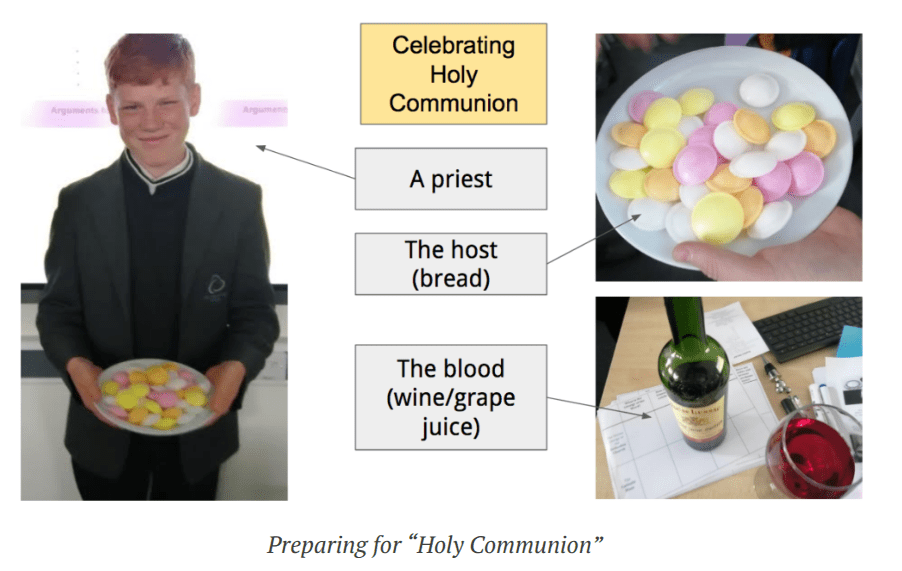
Similarly, pupils often recall mock baptisms with some excitement. Here, a doll symbolically has the word “sins” washed from its forehead, and reenactments of marriage, complete with vows and ceremonial roles. Such experiences help bring the content to life and anchor learning in emotionally resonant, memorable ways.

Year 11 pupils – who asked to re-enact the marriage ceremony they performed in year 10.
While it is important to recognise that these activities are not an end in themselves, they serve as a memorable introduction to more cognitively demanding tasks, which include the use of spaced retrieval practice, worked examples, and past paper questions further down the line. It should also be noted that these particular examples do not take too much time – 10 minutes at the most.
However, the excitement and engagement generated by these episodic memories, particularly when the topics are later revisited, suggest that such methods still have a valid place in our pedagogical toolkit.
If we want learning to be both memorable and meaningful, then the judicious use of episodic memory can make that learning more engaging, enjoyable, and ultimately more effective.
Why episodic memory matters in learning
Despite the emphasis placed on semantic memory – and its well-established importance for learning facts, concepts and procedures – there are compelling reasons why episodic memory also matters in education.
These two forms of memory are not mutually exclusive; they often overlap and support one another. As with so much in the current popular take on teaching and learning, we should be wary of false dichotomies. Episodic memories can reinforce semantic ones, just as semantic understanding can deepen episodic experiences.
Contextual anchoring: Episodic memories provide meaningful context, helping pupils relate abstract concepts to real-world experiences and vice-versa (Greenberg & Verfaellie, 2010). For example, pupils who learn physics through hands-on experiments often recall the activity (episodic memory) alongside the principle (semantic memory), reinforcing both.
Emotional engagement: Emotion plays a key role in memory. Learners who are emotionally invested – on a school trip, in a group project or through a powerful story – are more likely to retain the associated content (Tyng et al, 2017). Examples I have experienced or witnessed include the Last Post ceremony at the Menin Gate in Ypres, a visit from Holocaust survivors like the late Ziggy Shipper, or PSHE sessions such as the “Boobs and Balls” talk, where survivors or relatives affected by cancer speak about identifying potentially dangerous lumps – leaving a lasting impact through a blend of honesty and humour.
Personalisation and relevance: Linking information to personal experience improves retention. Teachers can prompt this through journaling, storytelling or drawing on pupils’ own lives. While trickier in some subjects, it’s still achievable – through well-chosen anecdotes (see my recent SecEd article on anecdotes) or, in geography, by keeping fieldwork journals that record both data and personal reflections.
Improved retrieval paths: Episodic memories are often encoded with multiple cues, including visual, auditory, emotional and contextual prompts, which support later recall (Baddeley, 2002). These cues act as mental bookmarks. For example, the role-plays in religious education discussed above create vivid, sensory experiences that pupils regularly draw on when recalling related concepts or vocabulary.
Strategies for using episodic memory in education
There are a numerous activities, strategies and interventions that can incorporate episodic memories. This can include:
Experiential learning: While often criticised, particularly by proponents of retrieval-based approaches, activities like simulations, role-play, lab experiments, and fieldwork engage pupils in real-world experiences that naturally generate episodic memories (Kolb, 1984). These do not replace explicit or direct instruction, spaced retrieval or practice but can – if the opportunity arises – act as a lever into a topic or a trigger for recalling key facts and processes.
Storytelling: As explained above, teachers can use stories – whether personal anecdotes or fictional narratives – to contextualise lessons. Pupils may also create their own stories to explain concepts or offer relevant examples, reinforcing learning through episodic embedding (McDrury & Alterio, 2003).
Reflective practice: When relevant, discussion groups and guided reflection help learners connect new knowledge with past experiences, making material more personally meaningful and memorable (Moon, 1999).
Spaced retrieval: Revisiting material by recalling when and how it was first encountered helps solidify learning. Prompts like “Where were you when you first learned this?” can reignite episodic traces. Regularly revisiting this material is shown to be impactful, especially if pupils are then tested on it (Cepeda et al, 2006). This can be combined with any of the strategies above.
Multi-sensory learning: Using visuals, sounds, movement or even smells can strengthen episodic encoding. For instance, I use photos from trips or activities to cue recall in GCSE revision. This doesn’t suit every subject or age group, but it can make revision more engaging and rooted in shared classroom experiences (Paivio, 1986).
Limitations and considerations
First, not all memories are equally accurate. Episodic memory is reconstructive and therefore not always precise. Unlike semantic memory, which stores general knowledge, episodic memory can be reshaped by time, emotion and later experiences (Conway, 2009). Pupils may recall events in ways that are incomplete or distorted. Teachers should be mindful of this and guide pupils to reflect critically on their experiences, especially when these are used to support academic understanding.
Second, over-reliance can skew understanding. While vivid experiences can enhance engagement, they may also lead to misconceptions if not properly framed. A pupil might remember a classroom activity but misinterpret the concept it was meant to teach. Episodic learning should therefore be supported by clear, explicit instruction. Pairing engaging experiences with precise conceptual explanation helps solidify correct understanding and avoid flawed ideas (Bransford et al, 2000).
Third, opportunities for episodic memory retrieval are limited. Teachers should not spend too much time trying to create situations for autobiographical memories. The idea, I think, is to access and leverage them if feasible and relevant.
Final thoughts
Episodic memories arguably add depth and durability to learning by grounding abstract knowledge in personal experience. When teachers strategically design learning environments that engage pupils emotionally and contextually, they can activate a powerful mechanism for understanding and recall.
Using episodic memories, therefore, is not to be ruled and consigned to the edumyth bonfire of yesterday’s learning techniques but can complement semantic learning and make quality first teaching more varied and engaging.
- Andrew Jones is assistant headteacher at The Reach Free School in Hertfordshire. He has been a teacher for 22 years. Find his previous contributions to SecEd via www.sec-ed.co.uk/authors/andrew-jones
Further information & resources
- Baddeley: The concept of episodic memory. In Baddeley, Aggleton & Conway (eds), Episodic memory: New directions in research, Oxford University Press, 2002: https://doi.org/10.1093/acprof:oso/9780198508809.003.0001
- Bransford et al (eds): How People Learn: Brain, mind, experience, and school, National Academies Press, 2000.
- Cepeda et al: Distributed practice in verbal recall tasks: A review and quantitative synthesis, Psychological Bulletin (132,3), 2006.
- Conway: Episodic memories, Neuropsychologia (47, 11), 2009.
- DfE: Initial teacher training and early career framework, January 2024: www.gov.uk/government/publications/initial-teacher-training-and-early-career-framework
- Greenberg & Verfaellie: Interdependence of episodic and semantic memory: Evidence from neuropsychology, Journal of the International Neuropsychological Society (16,5), 2010: https://doi.org/10.1017/S1355617710000676
- Kolb: Experiential Learning: Experience as the source of learning and development, Prentice-Hall, 1984.
- McDrury & Alterio: Learning Through Storytelling in Higher Education: Using reflection and experience to improve learning, Routledge, 2003.
- Moon: Reflection in Learning and Professional Development: Theory and practice, Routledge, 1999.
- Paivio: Mental Representations: A dual coding approach, Oxford University Press, 1986.
- Sealy: Memorable experiences are the best way to help children remember things. In The ResearchEd Guide to Edumyths, Barton (ed), John Catt Educational, 2019.
- Tulving: Memory and consciousness, Canadian Psychology (26,1), 1985.
- Tyng et al: The influences of emotion on learning and memory, Frontiers in Psychology (8), 2017: www.frontiersin.org/articles/10.3389/fpsyg.2017.01454
- Wheeler, Stuss & Tulving: Toward a theory of episodic memory: The frontal lobes and autonoetic consciousness, Psychological Bulletin (121,3), 1997.

