
Peer reviewed article originally published in Impact: Journal of the Chartered College of Teaching on 26 September 2023.
Over the past decade, researchers have gained a better understanding of spaced and interleaved practice as effective strategies for enhancing retention and retrieval performance (Bjork and Bjork, 2019; Brunmair and Richter, 2019; Donoghue and Hattie, 2021). Spaced practice involves distributing learning sessions over time, improving long-term retention, while interleaved practice mixes different topics or problems, enhancing comparison and contrast.
However, the concept of mixing syllabuses in an interleaved manner rather than teaching them in sequential blocks poses challenges, especially considering the need for pupils to master foundational knowledge before progressing to more complex material. Additionally, the practical and contextual constraints of the National Curriculum, GCSE and A-level syllabuses, which are predominantly designed for block teaching, are not adequately addressed by research on spacing and interleaving, which mainly relies on laboratory studies with adult learners (Firth et al., 2021).
Subsequently, this case study demonstrates how teachers can effectively utilise homework to incorporate spaced and interleaved practice without altering the curriculum. The study primarily focuses on the implementation of spaced and interleaved homework assignments in GCSE religious studies (RS) at The Reach Free School (TRFS) in Rickmansworth, Hertfordshire. The assignments were first used in the run-up to the 2019 summer examinations. It also includes a statistical analysis of results in eight GCSE subjects, comparing those using interleaved homework assignments and those using blocked assignments, along with student perspectives.
Into the classroom
Importantly, a small number of studies on the benefits of spacing and interleaving have been carried out in the classroom and show promise, particularly when homework is utilised (Rohrer et al., 2015, 2020). Moreover, researchers suggest that interleaved homework assignments can re-expose students to important information and compensate for limited review time in class (Carpenter et al., 2012).
Building on the above, teachers at TRFS have planned spaced and interleaved starter and homework tasks in RS, which are proportionally sequenced to ensure equally spaced coverage of the topics and units interleaved. For instance, GCSE pupils receive weekly 30-minute homework assignments that include three tasks requiring a five- to seven-minute response on the current topic taught, followed by five- to seven-minute and 15- to 16-minute responses on previously taught content. The shorter responses are based on five-mark exam questions and the longer response on a 12-mark question. Importantly, this allows teachers to focus the bulk of lesson time on delivering new content. Twelve-mark responses on the current topic are practised in lesson time. These interleaved tasks are distributed/spaced out, as per Table 1.
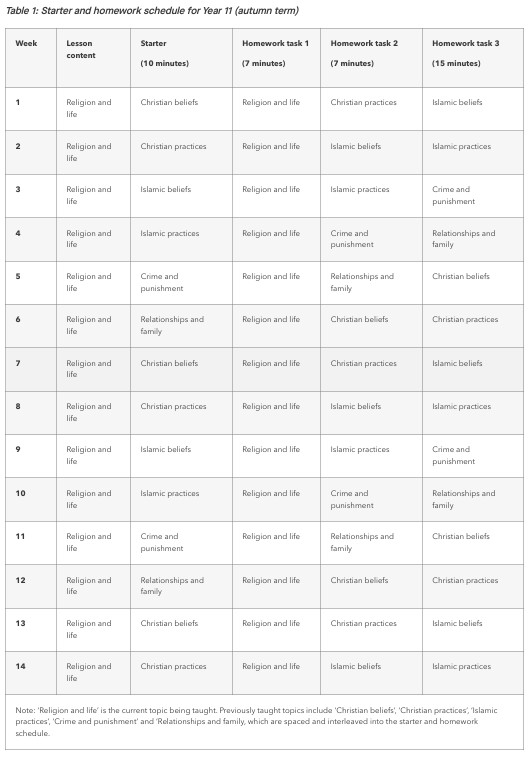
To optimise homework assignments, teachers also considered research suggesting that short practice tasks based on prior learning are more effective than project work or activities requiring pupils to learn new content (Jones, 2021). In this case study, the shorter homework questions focused on the articulation of knowledge and understanding, whereas the longer questions involved more analysis and evaluation. It should be noted, however, that these types of questions need to be modelled in class through worked examples and guided practice, in order to be effective at home.
Effect on attainment
The combination of interleaved starters and homework assignments appears to be effective. In 2018, before implementing interleaved homework, GCSE RS results had an average Progress 8 score of +0.6. However, after introducing interleaved homework, the 2019 cohort achieved a Progress 8 score of +1.72, and the 2022 results showed a score of +1.4 (note that there were no public GCSE examinations in 2020 and 2021). The average class size was 16 pupils.
Nonetheless, the above could simply be seen as an anomaly and does not isolate spaced and interleaved homework assignments over other interventions. To further examine the impact of spaced and interleaved homework assignments, a comparison was made using the school’s 2022 GCSE results data. Four option subjects that utilised spaced and interleaved homework assignments were compared to four option subjects that focused on blocked assignments. The average class sizes were 25 and 29, with a total of 99 and 116 pupils, respectively. On average, the subjects utilising spacing and interleaving had a higher Progress 8 score by +0.7. The application of Cohen’s d formula indicated an effect size of d = 0.59, which suggests a moderate impact on learning.
Furthermore, three of the four subjects that utilised interleaved homework in the run-up to the 2022 exams did not do so in 2019. Consequently, when comparing their GCSE results from 2019 to 2022, it was found that there was an average improvement of +0.8 in Progress 8 scores. The average class sizes for these subjects were 25 and 21, comprising a total of 99 and 84 students, respectively. Once again, the effect size, measured using Cohen’s d, was moderately significant at d = 0.63. It should be noted that the spaced and interleaved homework assignments used by these subjects were based on the RS model, which was disseminated at internal staff training sessions following the 2019 GCSE results.
The Cohen’s d effect sizes were calculated by taking the difference between the means of the sample groups’ Progress 8 scores and dividing it by the pooled standard deviation of samples used, which provides a standardised measure of the difference between groups. Although it is important to acknowledge the limitations of using effect sizes in a case study like this (see below), these figures suggest some consistency in trying to identify the positive impact of spacing and interleaving.
Positive responses from pupils
In order to ascertain the reaction of learners in this case study, the teachers canvassed the views of Key Stage 4 and 5 pupils in RS and A-level sociology, where homework is also interleaved at spaced intervals. Quantitative and qualitative surveys were used to compare their opinions on interleaving before and after it was introduced (for Year 11s and 13s, this did involve casting their minds back two years).
Despite initial hesitation, pupil surveys overwhelmingly support the use of interleaved homework assignments. Of the 79 pupils surveyed, 55 per cent were apprehensive when initially confronted with interleaved homework assignments, whereas 99 per cent now believe that ‘Interleaving improves their knowledge and understanding of taught content’. Typical comments on their thoughts before the introduction of interleaving included ‘I didn’t like the idea of completing work we weren’t doing in class. I thought I would get confused’ and ‘I thought it was better to focus on what you were learning at the time’. However, they now ‘get the opportunity to revise and go over all topic areas each term’, ‘can see the link between the topics better’ and are ‘not allowed to forget the things [they] have already learnt’. In some ways, this echoes the thinking of Bjork and Bjork (2019), in that spaced and interleaved practice is a ‘desirable difficulty’, as its long-term impacts override short-term uncertainties.
Limitations
While the findings suggest that spaced and interleaved homework assignments impact learning, it needs to be acknowledged that there are contextual as well as methodological limitations.
Firstly, the ability to set adequate and realistic spaced and interleaved practice assignments might be dependent on the type of questions asked in assessments and be more conducive to some subject areas than others. Secondly, the case study cannot be said to have isolated spacing and interleaving as adequately as more controlled experiments.
Nevertheless, I feel that there is considerable promise in this above case study to carry forward the idea that spaced and interleaved homework assignments can impact learning and attainment.
REFERENCES
- Bjork RA and Bjork EL (2019) The myth that blocking one’s study or practice by topic or skill enhances learning. In: Barton C (ed) Education Myths. Woodbridge: John Catt Publishing, pp. 59-72.
- Brunmair M and Richter T (2019) Similarity matters: A meta-analysis of interleaved learning and its moderators. Psychological Bulletin 145(11): 1029–1052.
- Carpenter SK, Cepeda NJ, Rohrer D et al. (2012) Using spacing to enhance diverse forms of learning: Review of recent research and implications for instruction. Educational Psychology Review 24: 369–378.
- Donoghue GM and Hattie JAC (2021) A meta-analysis of ten learning techniques. Frontiers in Education 6: 581–216.
- Firth J, Rivers I and Boyle J (2021) A systematic review of interleaving as a concept learning strategy. Review of Education 9(2): 642–684.
- Jones AB (2021) Homework with Impact: Why What You Set and How You Set It Matters. Abingdon: Routledge.
- Rohrer D, Dedrick RF, Hartwig MK et al. (2019) A randomized controlled trial of interleaved mathematics practice. Journal of Educational Psychology 112(1): 40–52.
- Rohrer D, Dedrick RF and Stershic S (2015) Interleaved practice improves mathematics learning. Journal of Educational Psychology 107(3): 900–908.
Photo credit: Leo Reynolds via Flickr (used under a Creative Commons Licence).
 Mr Jones' Whiteboard